
Print Is My New Algorithm
The strategic move for anyone who works with ideas and algorithms for a living is to protect the conditions that let you actually have ideas.

This issue of Social Signals was written to the Dirty Texans radio playlist.
The year is 25% complete, and that’s kind of freaking me out a little bit. It’s award season, and my teams are getting all kinds of great news about being short-listed for Shorty’s, Webby’s, ADDYs, and Silver Anvils (yes, I’m going to ask you to vote for us - see below).
But that also creates this sense of urgency inside of me — what have we done this year that’s truly GREAT work? What is industry-defining? What have we done in 2026 so far that we're so proud of that we’ll make case studies and trumpet throughout 2027? After all, a quarter of the year is over!!
This is the part of our industry and mindset that is both thrilling and exhausting. You’re never truly done and the rules keep changing. I’ve made a career out of playing that game and being excited for “what’s next.” But that doesn’t mean I don’t have anxiety about beating yesterday and ensuring we’re pushing for greatness wherever possible. Luckily, there’s still 75% of the year left, too!
I got a ton of great feedback on recent issues of Social Signals that talk about the temptation of outsourcing our humanity via agents, writing in my paper notebook to prove to myself and otheres that I’m still human, and how human storytellers are (still) the strategy.
So this week I thought I’d share another hack I’m using to keep my focus and to be very intentional in my content consumption — reading printed magazines, books, and turning off ALL notifications on my phone. Maybe this will help you, too.
Oh, and I’m calling out lazy April Fool’s creativity that should be the bar year-round, my biggest takeaway from Project Hail Mary, and sharing a link to a cool event I’m speaking at next week about maintaining your authenticity in an AI world. Let’s get into it! -Greg
🗞️ Print Is My New Algorithm
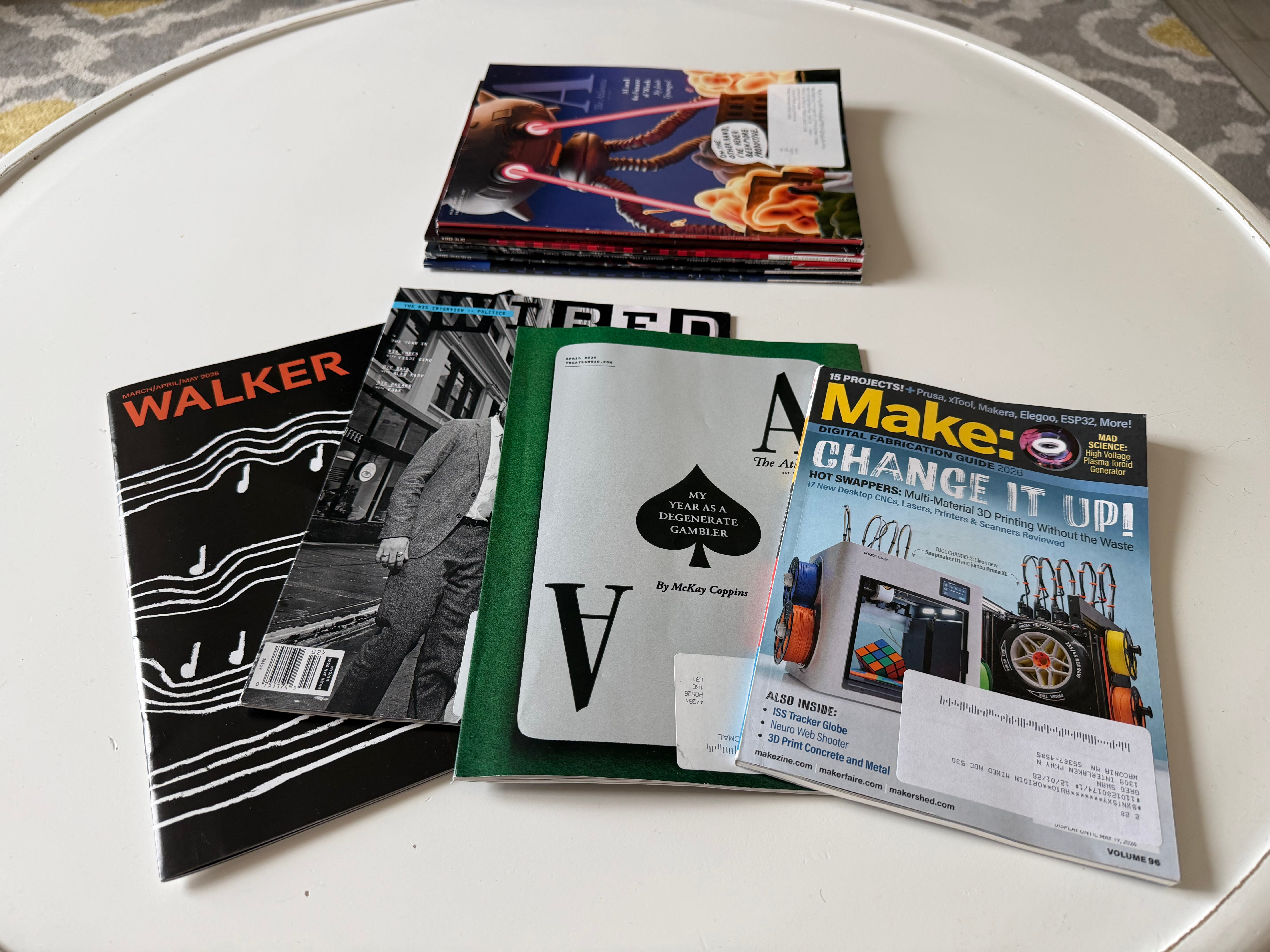
I have a confession: I’ve been getting my news via things printed on paper.
I have a print subscription to the MSP Business Journal, our local community weekly newspaper, Make Magazine, The Atlantic, and Wired.
These subscriptions mean I am snail-mailed physical copies of dead trees with yesterday’s news. This gives me plentiful information that in a format that sits on a table and doesn’t refresh when you pull it down.
It’s become one of my favorite parts of the day.
I call it my Slow Stack.
Remember when living room coffee tables and doctors’ office end tables used to be littered with printed magazines? I do!
And now I read magazines on airplanes. I read them sitting in a chair while sipping coffee in the morning. I read them at night while my wife crams for a test during school. There’s no feed to scroll. No sidebar of “recommended for you.” No notification pulling me sideways into someone else’s urgency.
It’s a great way to receive information slowly. Metered. Intentional. And my slow stack lets me do something I almost forgot how to do: think.
My slow stack also includes reading 100% paper books (and I read a lot of books). Paid subscribers can access my list of the 27 books I read in 2025 and 10 already on my bookshelf for 2026 here.
Now, I also pay for the Star Tribune and the NYT app and read longform content there, too. You all clearly know that I’m not anti-digital. I’m just… choosing when and how the information comes in.
In fact, I’ve had all the notifications turned off on my phone for a couple years now. No notification on my apps, email, Slack, news, or social.
Why? Because I’m going to check it anyway. I don’t need a buzz or a banner to remind me that new email exists. Of course a new email exists. Email is an infinite river of other people’s to-do lists. And it will be there when I decide to look at it. Same with texts. Same with social. Same with news.
The notifications don’t inform us. They interrupt us. And the interruption isn’t neutral. It trains a reflex that we know isn’t healthy, and yet we all have that coworker who has the Teams or Slack or Outlook notifications turned on you can hear the entire time you’re on a Zoom with them.
If we let things go, we’ll encounter a thousand micro-context-switches a day that feel productive while the research shows that they aren’t. So I turned them all off. I check things on my schedule instead of my phone’s schedule. And I miss things sometime. And some of you are probably reading this going “OMG, that’s why Greg is so bad at getting back to me!??!”
But meanwhile, I’m also getting rich value out of the content I’m consuming and being more intentional where I’m putting my focus.
Applying this for our daily work..
If you work in the attention economy (and if you’re reading this, you probably do), there’s something worth sitting with here.
We spend our days trying to earn attention. We optimize for clicks, impressions, open rates, scroll depth, and engagement metrics. We design notifications. We A/B test push alerts. We engineer urgency. We’re great at it!
And then we go home and drown in the very systems we helped build. And we feel bad about it.
There’s a signal in the fact that one of the most digitally immersed people you know (hi, that’s me) has started reading paper magazines in a chair and turned off every notification on his phone.
The best content doesn’t need to interrupt you to earn your attention.
A great Atlantic feature doesn’t need a push notification. It earns 20 straight minutes of my morning because the writing is that good. A local newspaper doesn’t need an algorithm. It earns my time because it tells me what’s happening on my street.
And when I read something in print, I process it differently. I’m slower, and more patient. I actually finish articles. I underline things. I fold pages. I think about what I just read before jumping to the next thing. That almost never happens when I’m reading on my phone.
I believe the strategic move right now for anyone who works with ideas and algorithms for a living is to protect the conditions that let you actually have ideas.
We’re living through a moment where in the first stages of AI generating more content than any human could consume in a hundred lifetimes and algorithms are getting better at feeding us exactly what we think we want.
Speed is easy. Thinking is hard. And thinking requires space that notifications and infinite feeds do not provide. Maybe that’s the most contrarian tech take I’ve ever had.
What about you? What have you done to take back your attention and be more intentional? Hit reply or leave a comment. I’d love to hear what’s working.
See you on the internet. And also, apparently, at the mailbox. -Greg
👨🚀 The Part About Project Hail Mary’s Use of Tech That You Maybe Missed
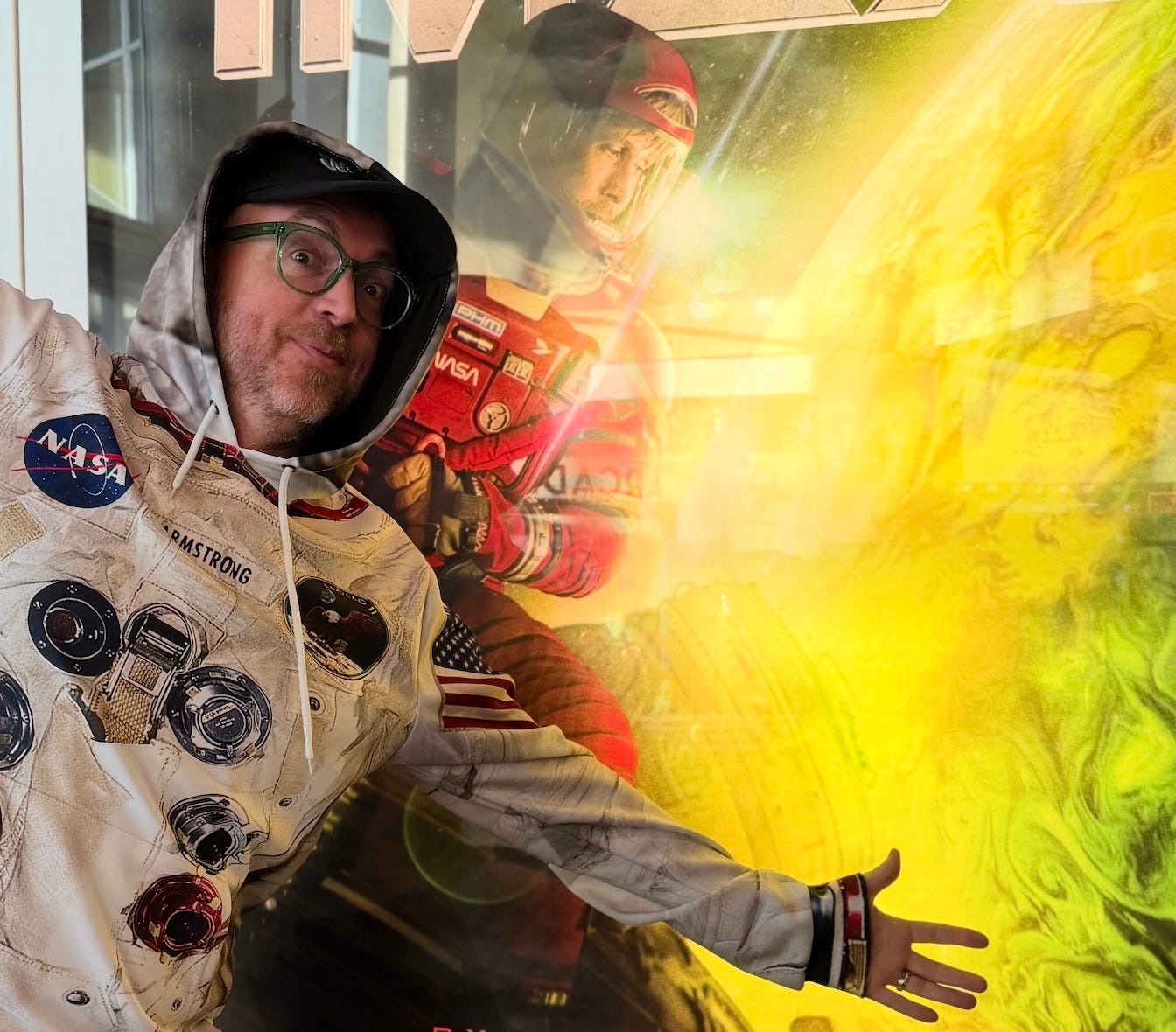
(SPOILER ALERT) One of the coolest parts of Project Hail Mary is watching Grace and Rocky build a way to understand each other from scratch. They do not share a language, a body, a culture, or even a planet, but they keep working at it.
They use technology to close the gap!! Grace leans on software, pattern recognition, and the tools around him to turn confusion into connection, and that process feels more meaningful than any shiny sci-fi gadget in the movie. It’s not generative AI, but it’s certainly using tech for its best possible use — enhancing communication!
Now, of course communication alone does not solve everything. It reveals difference and creates tension!! Rocky’s eating habits are horrifying from a human point of view. Grace sleeping alone without anyone keeping watch feels rude through Rocky’s lens. The point is not that one of them is right and the other is wrong. It is that understanding gives them a chance to see those differences clearly, then move past them with empathy, trust, and a shared purpose.
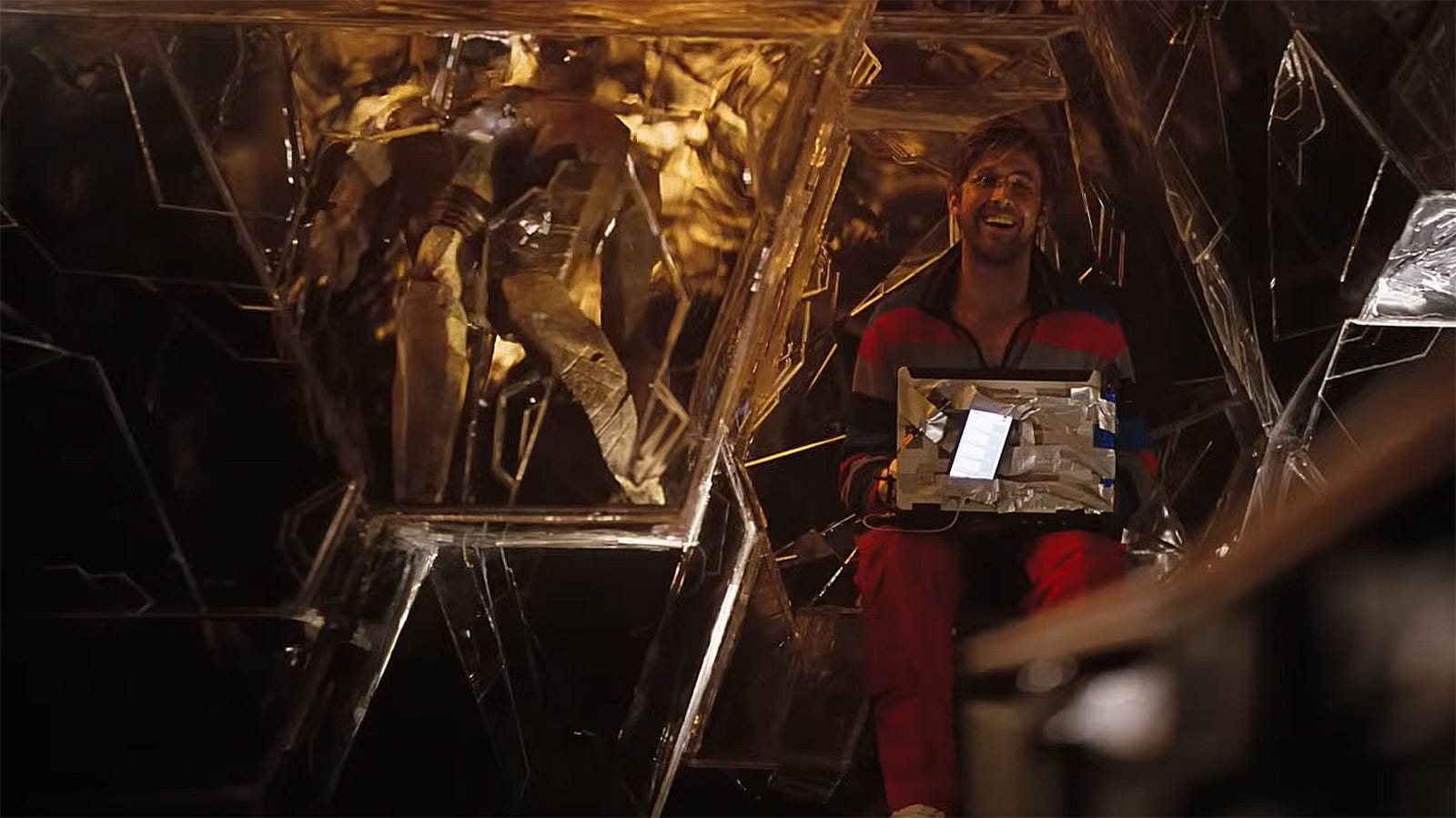
Without bridging that language and culture divide, the entire plot of the movie would have been terrible (and most likely at least two worlds would have perished).
This feels like a useful signal for the moment we are in with AI. The most exciting version of this technology helps people bridge language, culture, perspective, and assumption. It helps us get closer to each other, especially when the gap feels wide. Project Hail Mary gets at something hopeful there.
Better tools can help us communicate across real barriers, and when communication gets better, collaboration gets better too. Sometimes that is how you save the world. -Greg
🏆 Vote for The Shorty Awards!
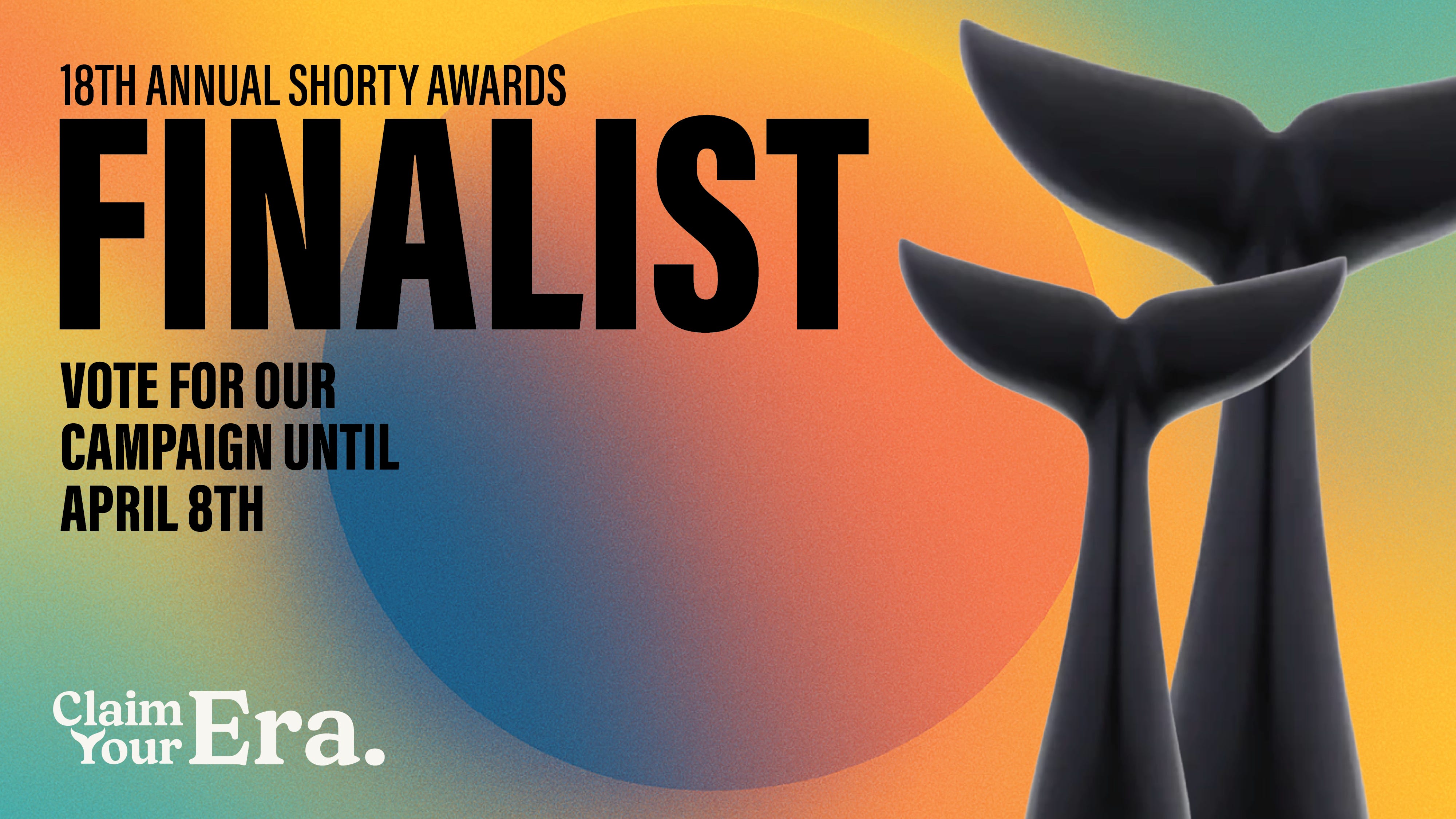
I’m super excited and proud to share that our teams at FINN Partners are a finalist in The Shorty Awards for FIVE awards.
Give us a vote toward the Audience Honor at the links above. And no, as a Shorty Judge I did not judge these categories! TIA!
🚀 To the Moon!
Bravo to Brittany Brown and the NASA social team for this promotion where you could submit your name to be included on an SD card to fly inside Orion in the Artemis II mission. Based on their website, there were 5,647,889 submissions - which is a lot of names!

This is such a simple and fun campaign. It creates ownership. There’s an asset/artifact to share on social (click above and see all the people sharing their boarding passes with me!). And there is hope in all of this that we really need right now. Here’s a vid of the chip!
Did you miss it? Sign up for NASA’s Virtual Guest program to be notified of future mission promos!
🏆 Vote for The Webby Awards!
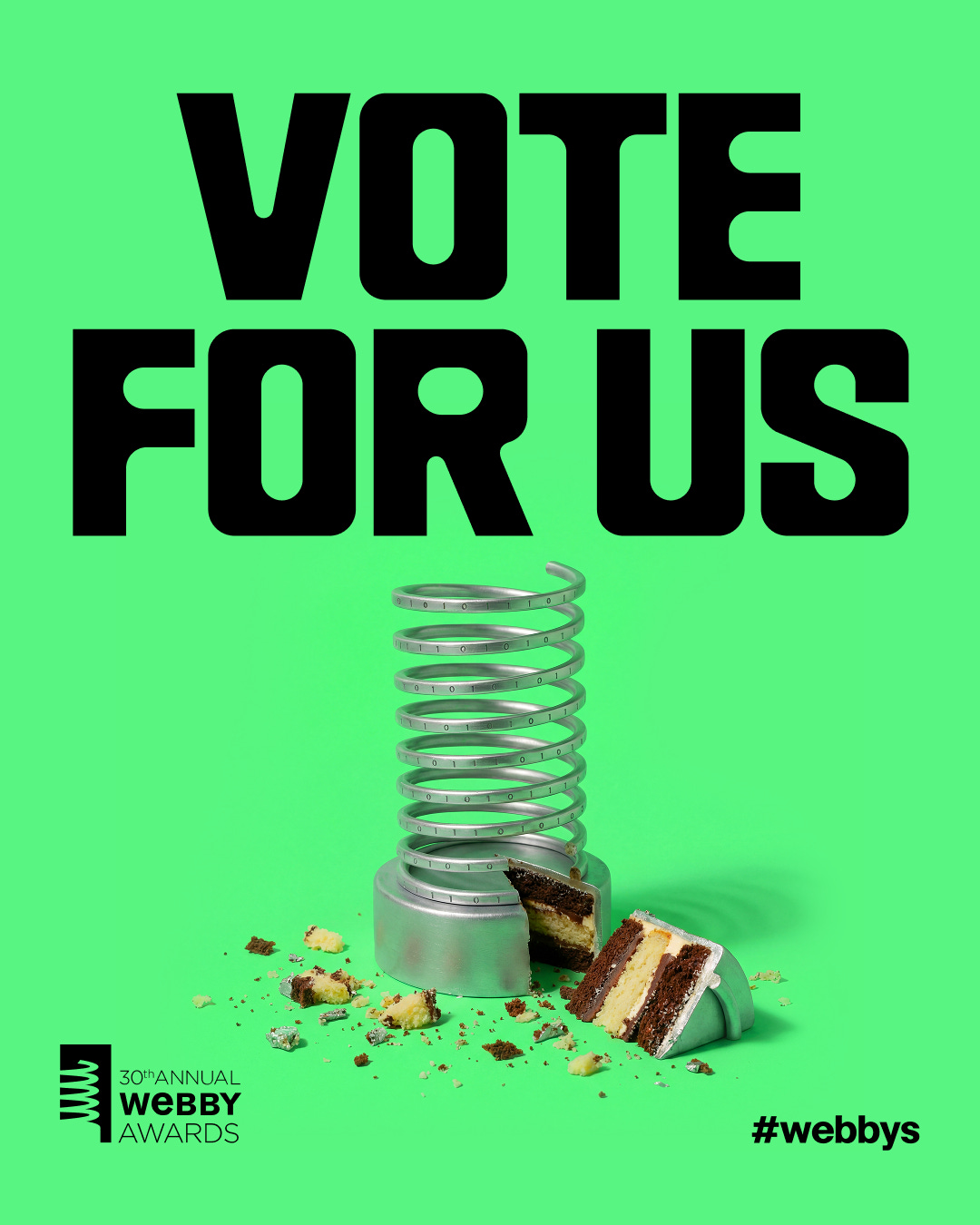
Another one! Hey… I’m super excited and proud to share we have a number of Webby Awards to share from my teams at FINN Partner.
Webby Nominations
Denny’s Sticky Kicks in the Advertising, Media & PR - Best Launch or Drop Category.
Borden Grilled Cheese in the Advertising, Media & PR - Best Use of Earned Media Category.
DECKED’s Dad Time Off in the Advertising, Media & PR - Best Cause Related Campaign Category.
Give us a vote at the links above! TIA!
🙃 Avoid the April Fools’ Trap
The April Fools’ Trap is real. Sometimes only once a year brands invest real creative energy, real production dollars, and sometimes their absolute best concepts into content that has a 24-hour shelf life and a built-in disclaimer that says “just kidding.”
If your April Fools idea makes people say “wait, I actually want that,” you didn’t make a joke. You made a product insight and ran a focus group disguised as a meme. And then you walked away from it.
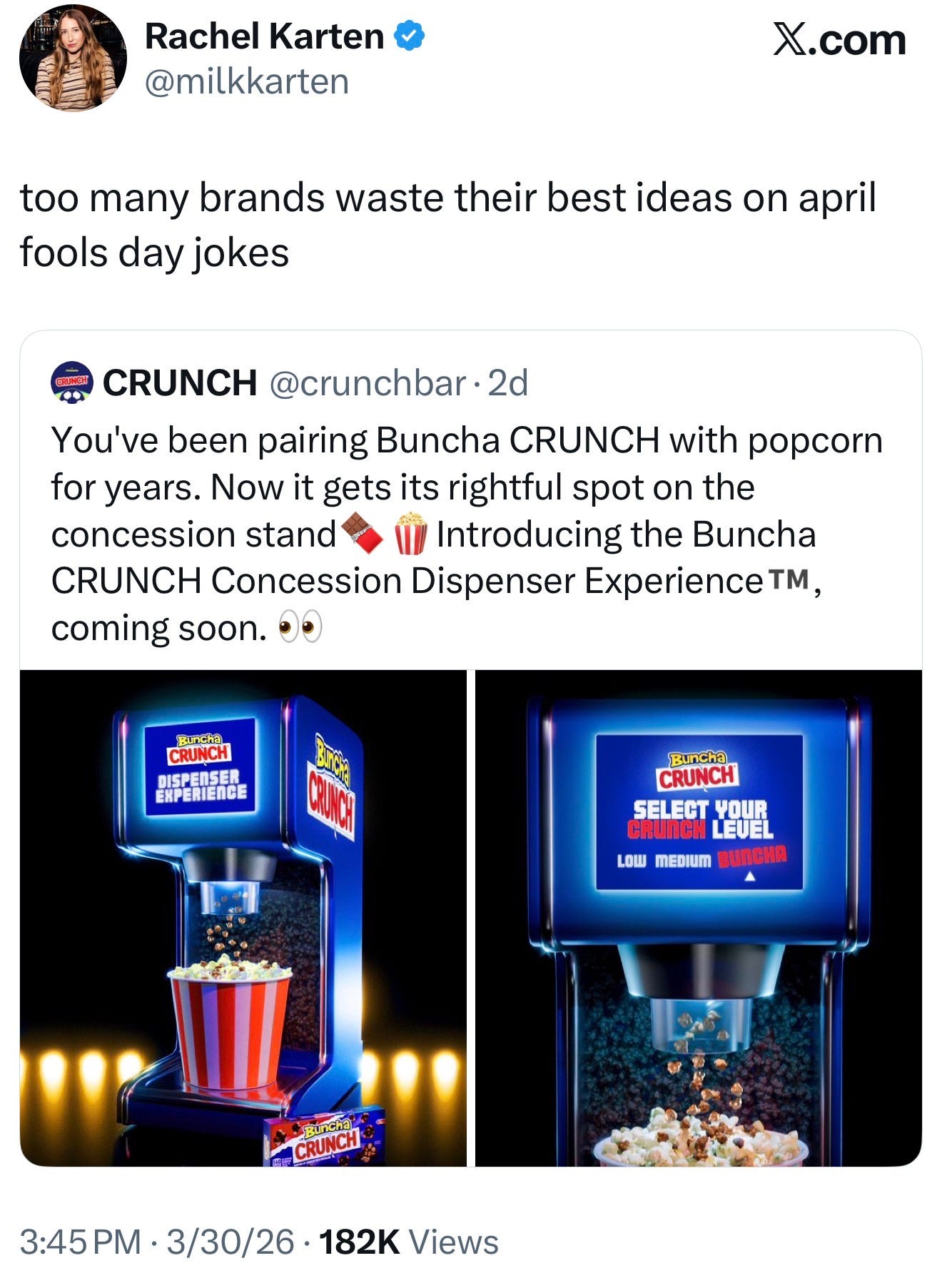
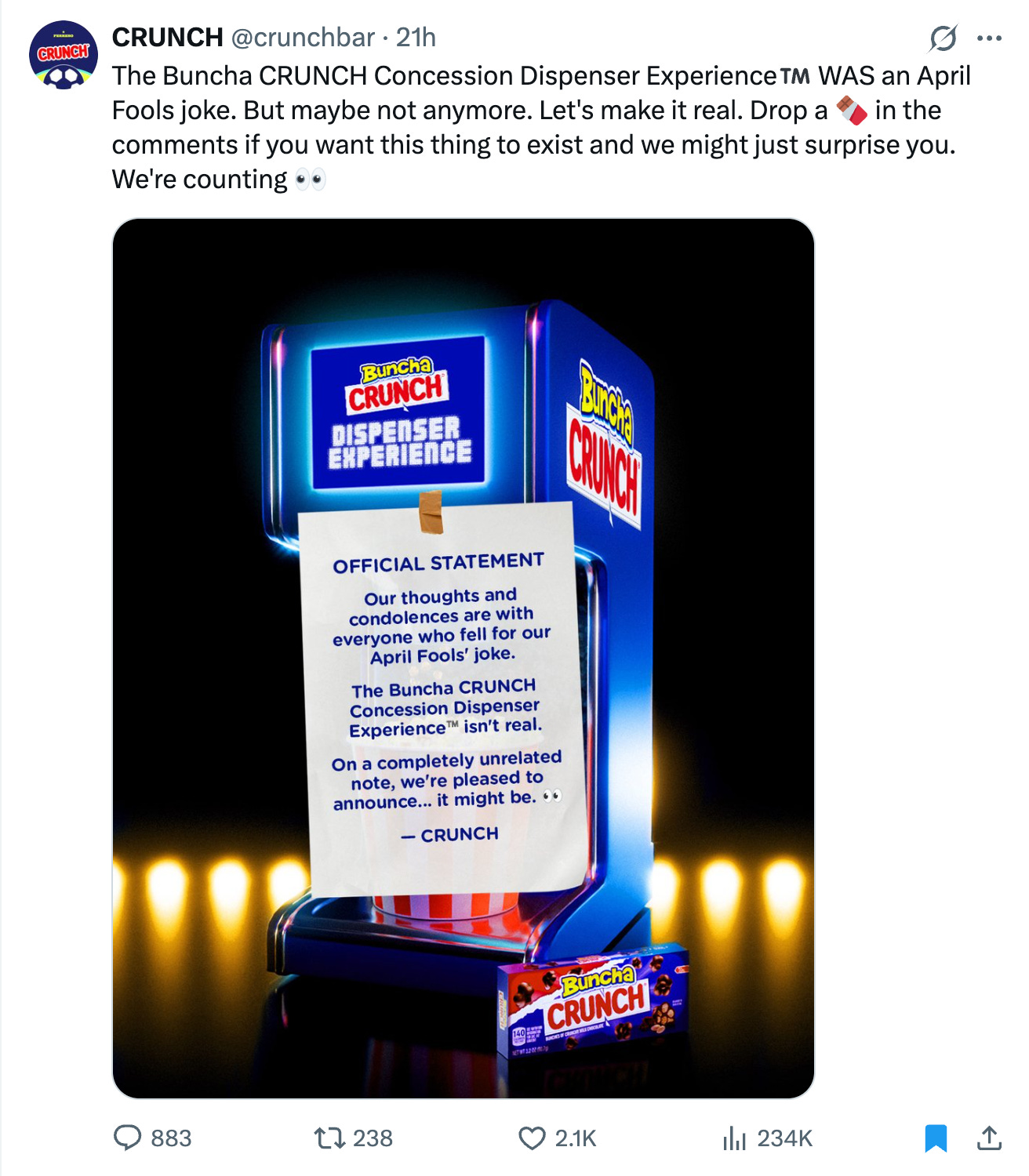
And if you didn’t plan ahead to make it real, the next-best brands then LISTEN and act from there.
Another brand that “gets it” is Yahoo. Three years running, they’ve turned April Fools into an actual commerce moment.
Keyboard oil for loud typers. The Touch Grass keyboard. And this year’s Scrōll Stoppr, a little finger accessory that physically blocks your thumb from doomscrolling, available on TikTok Shop for $4.99 in a box that plays the Yahoo yodel.
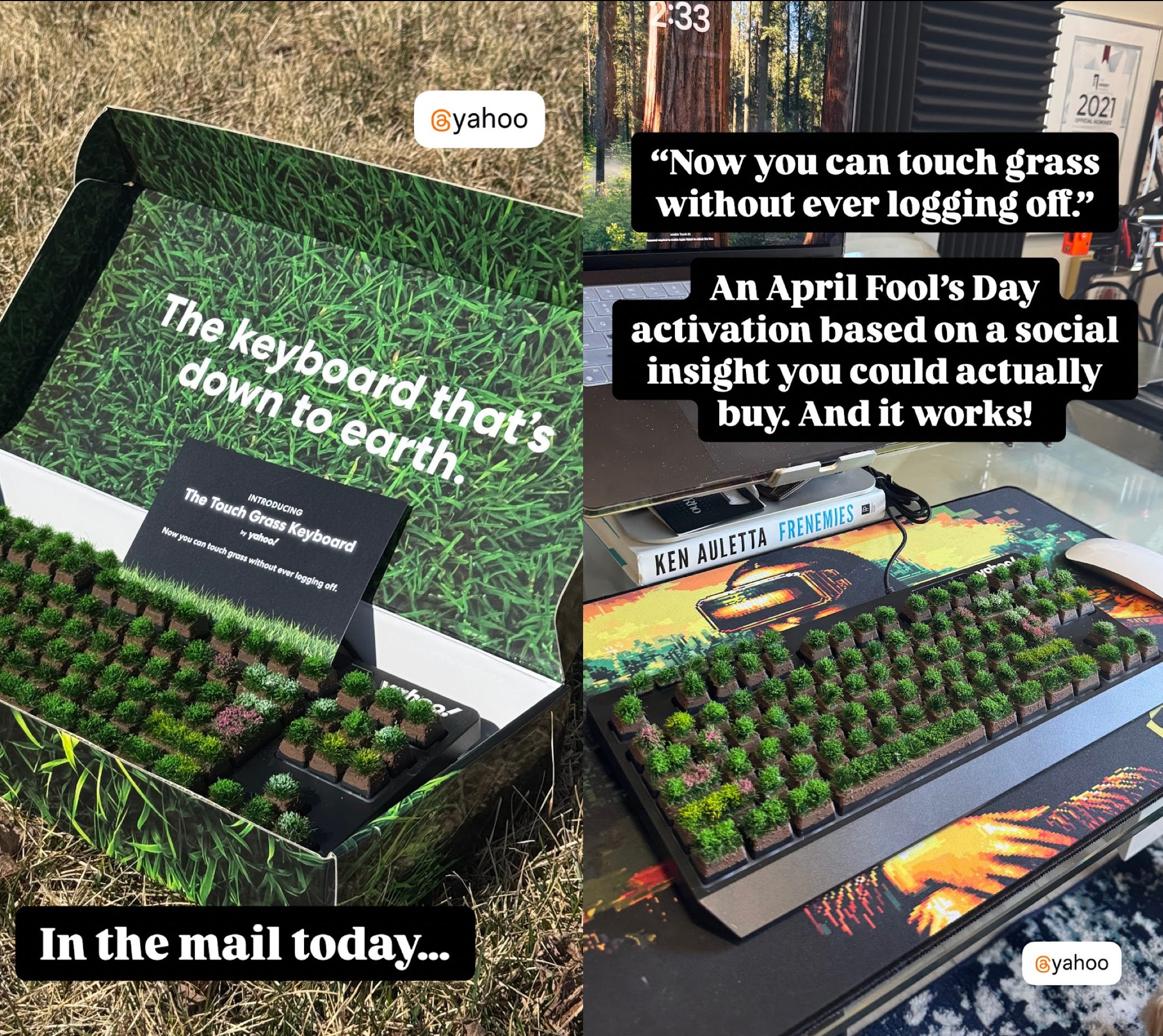
Each one of these takes a real internet behavior insight, packaged it as something absurd enough to earn press and engagement, and then make it real enough that you could actually buy it. That’s not a prank. It’s a brand activation that happens to hit on April 1st. And yes, I bought a Touch Grass keyboard (that’s mine in the pic).
I’ve also worked on some fun April Fools’ day promos that were REAL, including this year’s Panda Express milk prank, and when Arby’s and Warby Parker got together to launch WArby’s. Mmm… onion ring monocles!
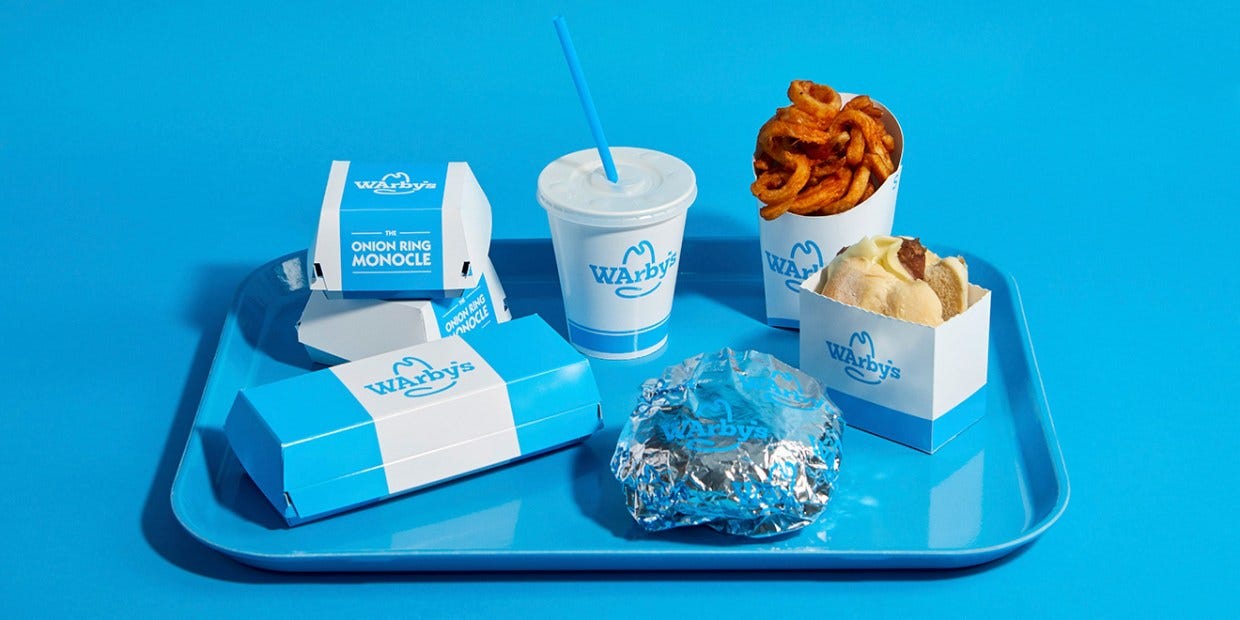
My encouragement for you here is not to stop at the joke. Instead, look for ways to create branded moments that earn attention ALL THE TIME.
If your April Fools’ post got a better reaction than your last real product launch or activation, I think you have enough intel to make some different decisions for the rest of 2026.
🎤 See Greg Live in 2026
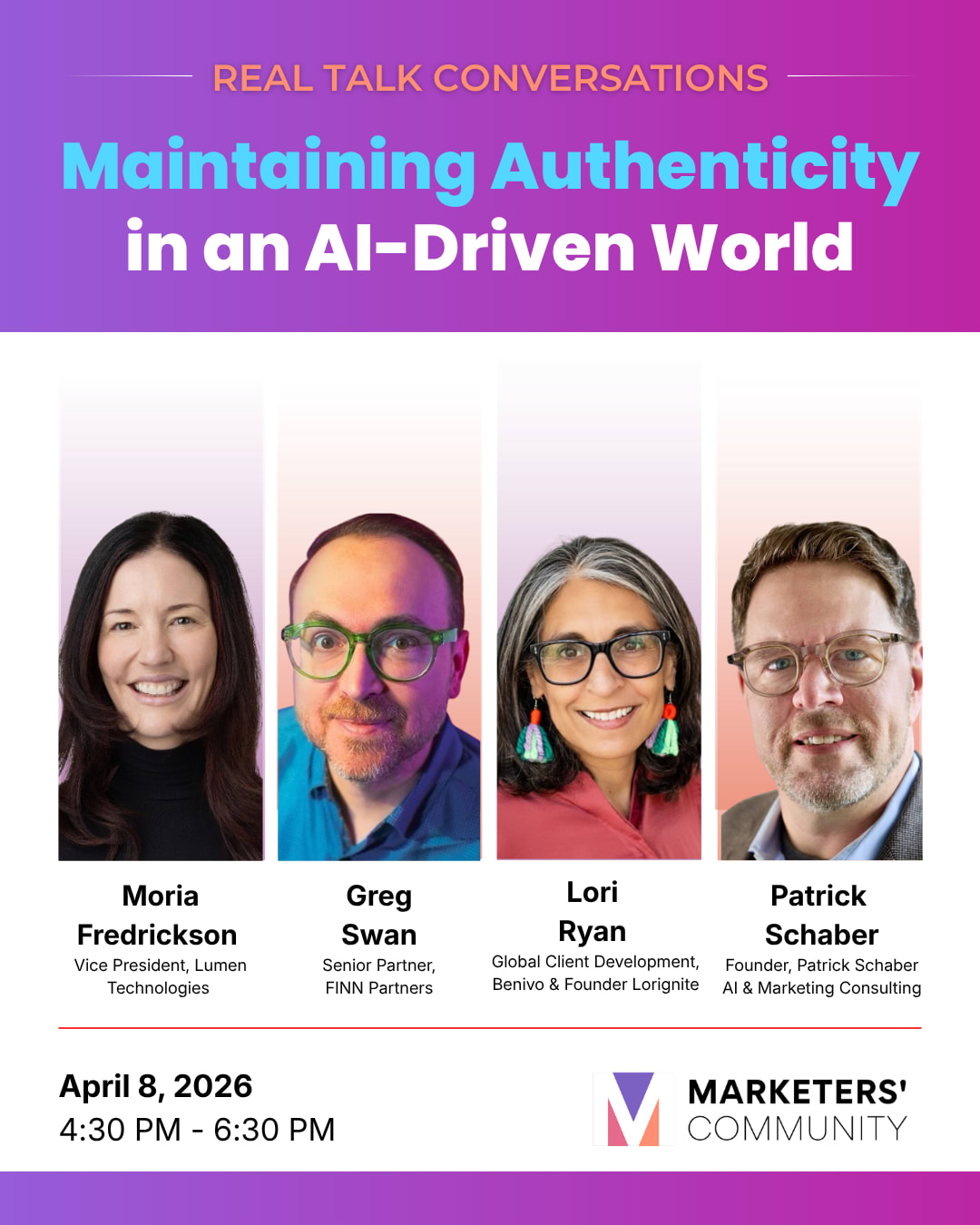
Marketers’ Community: Maintaining Authenticity in an AI-Driven World - April 8 (RSVP here)
To inquire about Greg speaking at your event or with your team, email greg (at) gregswan (dot) net
See you on the internet! Keep going!✨
Greg